
Investing in Dubai
Dubai Metro Lines 2026: Complete Guide
Font Size :
Table of Contents
Dubai is a city synonymous with innovation, luxury, and seamless connectivity. At the heart of its world-class infrastructure lies the Dubai Metro, a state-of-the-art, fully automated, driverless rail network that has redefined urban transit since its launch in 2009. Whether you are a resident navigating daily life or a discerning visitor exploring iconic landmarks, understanding the Dubai Metro lines is essential for a smooth, sophisticated, and time-efficient travel experience.
Operated by the Roads and Transport Authority (RTA), the Dubai Metro is one of the longest fully automated metro systems in the world, spanning over 80 kilometers of track. It connects the city's most vibrant neighborhoods, premier business districts, and world-renowned attractions — all in air-conditioned comfort. Beyond its role as a transport system, the Metro has emerged as one of the most powerful drivers of real estate value in the city, reshaping entire neighborhoods and creating extraordinary investment opportunities.
This comprehensive guide covers everything you need to know about the Dubai Metro: its current routes, luxury travel options, the highly anticipated future expansions — including the groundbreaking, newly announced Golden Line — and the profound "Metro Effect" on Dubai's property market.
The Backbone of Dubai: The Red and Green Lines
The Dubai Metro currently operates two primary lines — the Red Line and the Green Line — each serving distinct corridors of the city with precision and efficiency.
The Red Line: Connecting the Modern Metropolis
The Red Line is the main artery of the Dubai Metro network, stretching from Rashidiya in the northeast all the way to Expo City in the south. This is the busiest and most strategically important line, linking Dubai International Airport, the city's central business district, and its most celebrated leisure destinations. It seamlessly connects passengers to key areas such as Downtown Dubai, Business Bay, Dubai Marina, and major shopping centers, making it indispensable for both business travel and leisure exploration. Trains arrive every 2 to 4 minutes during peak hours and every 5 to 7 minutes during off-peak periods, ensuring minimal waiting times.
The Green Line: Exploring Heritage and Culture
While the Red Line serves the modern face of Dubai, the Green Line offers a journey through the city's historic and cultural soul. Running from Al Qusais to Al Jaddaf, the Green Line serves areas rich in heritage and tradition. This route is perfect for those looking to explore traditional markets, historical neighborhoods, and the scenic Dubai Creek area. Transfers between the Red and Green lines are seamlessly facilitated at major interchange stations, ensuring smooth connectivity across the entire city.
The Future of Transit: Blue and Golden Lines
Dubai's relentless commitment to innovation is most powerfully demonstrated in its ambitious upcoming metro expansions, designed to cater to a rapidly growing population and elevate city-wide connectivity to unprecedented levels.
The Dubai Metro Blue Line
Scheduled for completion in 2029, coinciding with the Metro's 20th anniversary, the Blue Line will significantly enhance connectivity across the city. Spanning 30 kilometers and introducing 14 new stations, it will connect key areas such as Dubai Creek Harbour, Dubai Festival City, International City, and Dubai Silicon Oasis. This expansion is projected to serve approximately one million residents and decrease traffic congestion by 20 percent, with the world's tallest metro station set to be built at Dubai Creek Harbour.
The Revolutionary Golden Line: Dubai's Boldest Transport Vision
In a landmark announcement made on April 22, 2026, His Highness Sheikh Mohammed bin Rashid Al Maktoum revealed plans for the extraordinary new Golden Line — a Dh34 billion project that will stand as the largest transport initiative in the history of Dubai. This is not merely an expansion; it is a complete reimagining of how the city moves.
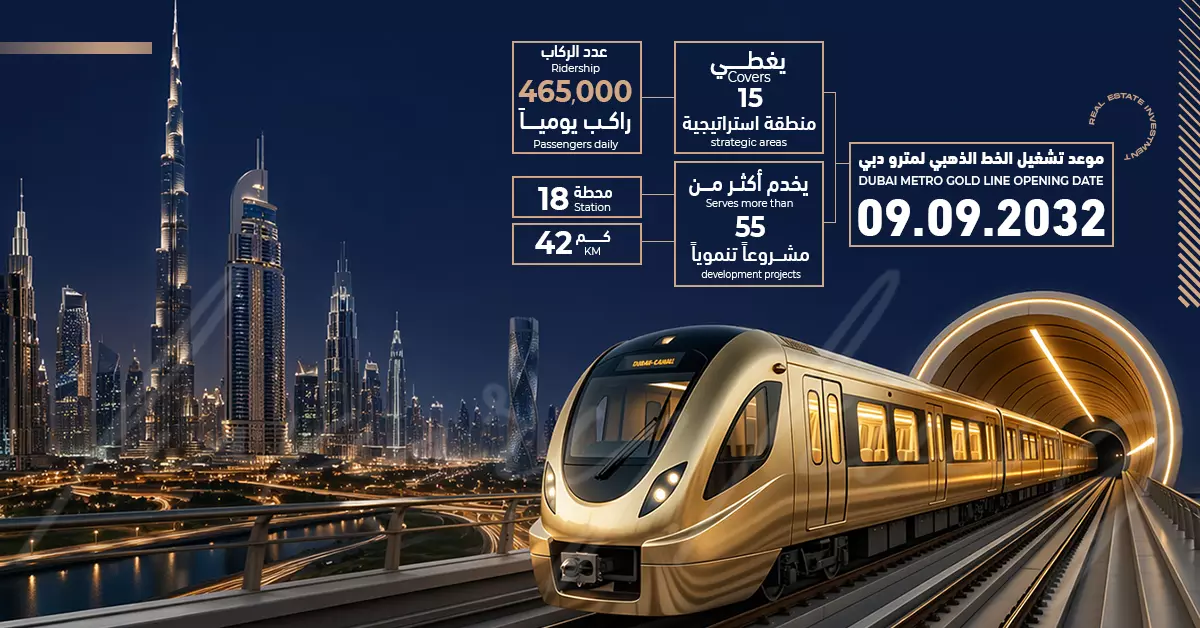
The Golden Line will be a fully underground, 42-kilometer route featuring 18 stations that pass through 15 key strategic areas across the city. The line begins in Dubai's historic centre at Al Ghubaiba and stretches all the way to Jumeirah Golf Estates, traversing some of the city's most dynamic and high-growth districts including City Walk, Dubai Hills, Meydan, Global Village, Jumeirah Village Circle, and Dubai Production City.
The tunnel network will be equivalent to twice the length of all current Dubai Metro tunnels, built using advanced tunnel-boring technologies, and is expected to be completed 30 percent faster than the ongoing Blue Line project. The official completion date is set for September 9, 2032 — the 23rd anniversary of the Dubai Metro.
The Golden Line is designed to serve approximately 1.5 million residents and will strengthen connectivity to 55 major real estate developments currently under construction. Daily ridership is expected to reach 465,000 passengers beyond 2040. The line will connect with the Red Line at two locations, the Green Line at one location, and twice with the Etihad Rail passenger service, integrating Dubai's metro into a truly national transport network.
"Our future endeavours will not stop; rather, they will accelerate. Our plan is to build a better future for millions of people. We stand by our words and deliver on them."
—HH Sheikh Mohammed bin Rashid Al Maktoum, April 22, 2026
Upon completion, the Golden Line will increase the total length of the Dubai Metro network by 35 percent, cementing Dubai's position as one of the world's most connected and forward-thinking cities.
The "Metro Effect": How Dubai Metro Transforms Real Estate
The expansion of the Dubai Metro is not merely a transport upgrade — it is one of the most powerful catalysts for real estate appreciation in the city's history. The "Metro Effect" is a well-documented phenomenon in Dubai, where proximity to transit hubs consistently and significantly boosts property values, rental yields, and investment returns.
Capital Appreciation: A Proven Track Record
The historical evidence is compelling. Following the launch of the Red and Green lines, areas within walking distance of stations recorded price appreciations of over 50 percent between 2010 and 2018, according to data from Springfield Properties CEO Farooq Syed [1]. This pattern is now being replicated with the upcoming Blue Line, and is set to repeat itself on an even grander scale with the Golden Line.
Capital appreciation data from previous line openings shows a 10 to 30 percent premium in transaction prices within 2 kilometers of new stations. The widest appreciation window is in the 12 to 24 months around the route announcement and the 6 to 12 months following line opening — making the current period, following the Golden Line announcement of April 2026, a strategically significant entry point for investors .
Rental Yields and the "Station Premium"
The impact on rental income is equally significant. Once train services begin, sale prices for properties near stations can command up to a 15 percent premium compared to those situated farther from the stations, according to Haider Tuaima, Managing Director and Head of Real Estate Research at ValuStrat . Properties located within a 10-minute walk (700 to 1,000 meters) of metro stations consistently attract heightened investor interest, lower vacancy rates, and faster resale cycles.
In Dubai Silicon Oasis, a key district on the Blue Line route, property prices have already increased by over 50 percent in the past 12 months, with sales volume up 81.6 percent and transaction value rising 147 percent . Rental yields in the same area are projected to remain robust at 8 percent or above as the Blue Line nears completion .
Emerging Investment Hotspots Along New Metro Corridors
The new metro lines are systematically transforming previously car-dependent neighborhoods into high-demand investment hotspots. In International City, newer buildings within a 700-meter radius of planned Blue Line stations are already recording a 21 percent jump in rental demand . Academic City is also seeing a surge in build-to-rent interest, as the metro makes it accessible to over 27,000 students.
For luxury real estate, Dubai Creek Harbour stands out as the marquee beneficiary of the Blue Line. It will host the "Emaar Properties Station," set to be the world's tallest metro station at 74 meters. The capital value appreciation here is expected to reach 15 to 20 percent, transforming the district from an "emerging choice" into the definitive "New Downtown" of the East .
Looking ahead, the Golden Line's corridor — spanning from Al Ghubaiba through City Walk, Dubai Hills, Meydan, and Jumeirah Golf Estates — represents the next generation of metro-driven real estate opportunity. With 55 major real estate developments directly connected to the Golden Line, the investment thesis is both clear and compelling.
For those seeking to capitalize on Dubai's metro-driven real estate boom, expert guidance is essential. Explore the finest investment-grade properties and luxury residences with Bloom Luxury Signature — where every acquisition is a statement of excellence.
Elevating the Journey: The Gold Class Experience
For those who seek the utmost comfort, privacy, and exclusivity, the Dubai Metro offers the Gold Class — a premium travel tier that transforms a routine commute into a refined experience. By obtaining a premium access card, passengers gain exclusive entry to dedicated Gold Class cabins located at the front of the train.
These cabins are distinguished by wider, premium leather seating with superior cushioning, extra legroom for a relaxed and unhurried journey, panoramic front-facing views of the city's evolving skyline, and a quieter, less crowded environment ideal for business reflection or leisure. The Gold Class experience is particularly valued by business professionals, luxury travelers, and those visiting Dubai for high-end real estate or investment purposes.
Navigating the System: Fares and Operating Hours
The Dubai Metro operates on a fully cashless basis using smart transit cards. Fares are calculated based on the number of zones crossed during the journey, making it one of the most affordable and efficient urban transport systems in the world. It is essential to tap in upon entering and tap out upon exiting to ensure the correct fare is charged.
The Metro generally operates from 5:00 AM to midnight during the week, with extended hours on Fridays and public holidays to accommodate the city's vibrant nightlife, events, and cultural celebrations.
Frequently asked questions
What are the operating hours of the Dubai Metro?
The Dubai Metro operates from 5:00 AM to midnight from Monday to Thursday. On Fridays, service extends to 1:00 AM. Saturday services run from 5:00 AM to midnight, while Sunday services begin at 8:00 AM.
How do I transfer between the Red and Green lines?
Transfers between the Red and Green lines are available at designated major interchange stations. No additional fare is charged for transferring within a single journey, provided you do not exit the paid zone.
Is the Dubai Metro Gold Class worth it?
For travelers who value comfort, privacy, and panoramic views, the Gold Class is absolutely worth the premium. The wider seats, reduced crowds, and front-of-train vantage point make it a distinctly superior experience, particularly during peak hours.
What is the new Dubai Metro Golden Line?
The Golden Line is a newly announced, fully underground metro line spanning 42 kilometers with 18 stations. Approved by HH Sheikh Mohammed bin Rashid Al Maktoum on April 22, 2026, it represents a Dh34 billion investment and is scheduled to open on September 9, 2032. It will serve 1.5 million residents and connect 15 strategic areas from Al Ghubaiba to Jumeirah Golf Estates.
How does the Dubai Metro affect property prices?
Proximity to the Dubai Metro significantly boosts property values. Properties within a 10-minute walk of stations can command up to a 15 percent premium in sale prices. Historically, areas near new metro lines have recorded over 50 percent price appreciation in the years following a line's launch.
When is the best time to invest in property near a new metro line?
The optimal investment window is in the 12 to 24 months around the route announcement and the 6 to 12 months following line opening. The period immediately following the Golden Line announcement (April 2026) represents a significant early-entry opportunity.
Can I travel from Dubai International Airport using the Metro?
Yes. The Red Line provides direct, seamless access to Dubai International Airport, with dedicated stations at both Terminal 1 and Terminal 3. The journey from the airport to Downtown Dubai takes approximately 30 minutes.