
Real Estate Blog
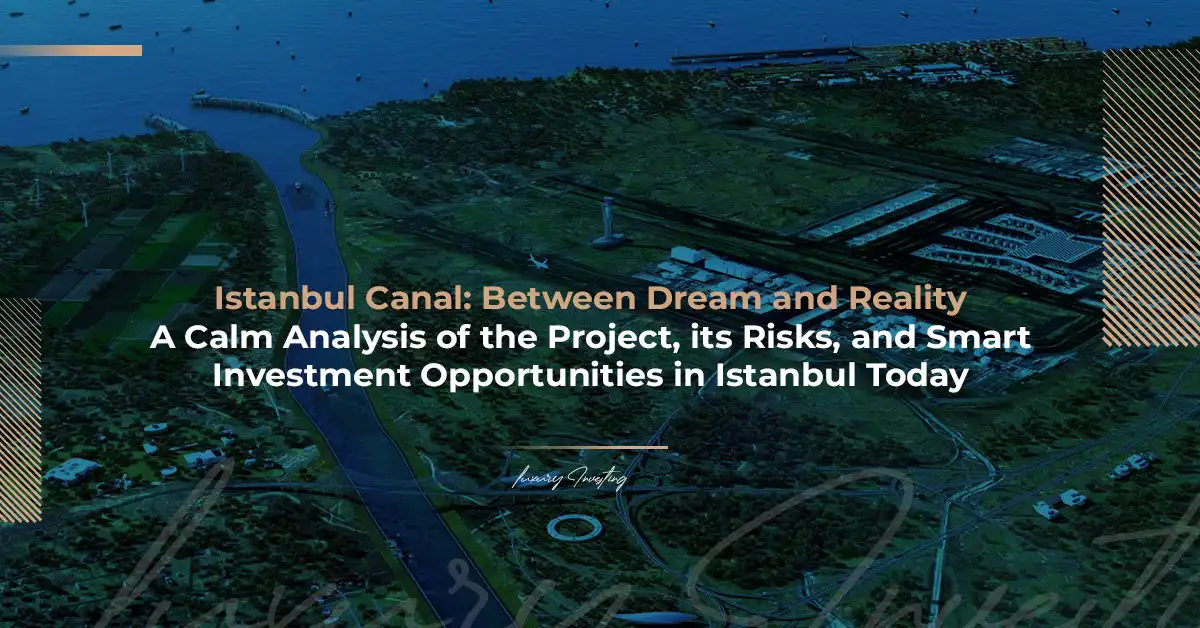
Istanbul Canal: Between Dream and Reality: A Calm Analysis of the Project, its Risks, and Smart Investment Opportunities in Istanbul Today
Font Size :
Table of Contents
- 1. What Is Canal Istanbul? (A Brief Definition and Key Figures)
- 2. Timeline of the Project (Brief Overview)
- 3. Who Officially Manages Canal Istanbul?
- 4. Promotion of Canal Istanbul: Politics vs. Real Estate Marketing
- 5. Scientific and Judicial Assessments (2024–2025)
- 6. What Is Actually Happening in Yenişehir Today?
- 7. Future Scenarios for Canal Istanbul
- 8. What Does Canal Istanbul Mean for Smart Investors Today?
- 9. Comprehensive Q&A
- 10. Conclusion: Between Myth and Reality
1. What Is Canal Istanbul? (A Brief Definition and Key Figures)
Introduction
Since its first announcement in 2011, the Canal Istanbul project has sharply divided public opinion in Turkey and abroad. Some view it as a “Project of the Century” that would transform Istanbul into a new maritime capital, while others describe it as an environmental and financial disaster threatening the city’s water resources, ecology, and long-term economic stability.
This analytical report deliberately avoids both promotional rhetoric and ideological opposition. Instead, it aims to get as close as possible to the facts by addressing the following questions:
-
What exactly is Canal Istanbul, based on official figures and maps?
-
Which government institutions are formally responsible for the project?
-
What do recent scientific reports and court rulings in Turkey actually say?
-
What is really happening today in the Yenişehir area along the planned route?
-
And most importantly for investors: where are the real opportunities in Istanbul today, beyond the noise?
The goal of this file is to serve as a balanced reference for investors, journalists, and analysts—grounded in current realities, while outlining realistic future scenarios.
Definition of the Project
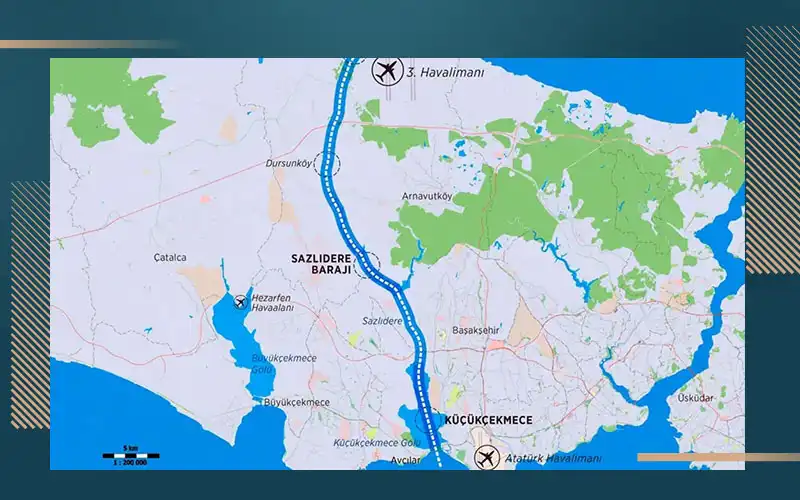
Canal Istanbul (Kanal İstanbul) is a planned artificial waterway on the European side of Istanbul, designed to connect the Black Sea in the north with the Sea of Marmara in the south, running parallel to the Bosphorus Strait.
Key Official Figures
-
Approximate length: ~45 kilometers
-
Width: between 275 and 360 meters on average
-
Depth: approximately 20–21 meters, allowing passage of large vessels
-
Target capacity: up to 160 ships per day
Planned Route
The proposed route begins at Küçükçekmece Lake on the Sea of Marmara, passes through the Sazlıdere Valley and Sazlıdere Dam, continues north through rural areas of Arnavutköy, and reaches the Black Sea.
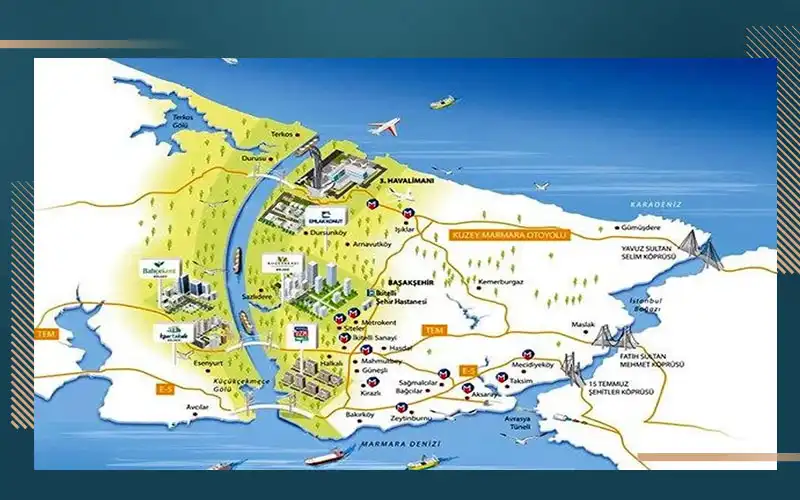
Along the canal corridor, a new city branded as “Yenişehir – Istanbul Yenişehir” is planned, including residential and commercial districts, ports, bridges, and modern infrastructure.
2. Timeline of the Project (Brief Overview)
-
Pre-2011: The idea of an alternative waterway dates back to Ottoman-era engineering concepts but was never implemented.
-
2011: Official announcement by Recep Tayyip Erdoğan as the “Crazy Project” (Çılgın Proje).
-
2019–2020: Completion of Environmental Impact Assessment (ÇED) studies; issuance of “ÇED Positive” approval; launch of 1/100,000, 1/5,000, and 1/1,000 master plans for Yenişehir as a Rezerv Yapı Alanı (Reserve Construction Area).
-
2021: Official ceremonies marking the start of bridge and road works linked to the project, without large-scale canal excavation.
-
2022–2024: Continued revisions of Yenişehir zoning plans; expansion of residential construction; multiple lawsuits filed by Istanbul Metropolitan Municipality (İBB) and professional chambers such as TMMOB.
-
2024–2025: Partial court rulings annulling some planning decisions, followed by procedural appeals; ongoing construction of public and private housing projects in Yenişehir, while actual canal excavation has still not begun.
Summary: As of the end of 2025, the canal itself remains largely a paper project, while urban development around the planned route is actively progressing.
3. Who Officially Manages Canal Istanbul?
1) Presidency of the Republic of Türkiye
The project is part of the presidency’s declared strategic vision and is politically presented as a sovereign, geopolitical initiative.
2) Ministry of Transport and Infrastructure
-
Considered the owner of the canal project itself.
-
The General Directorate of Infrastructure Investments is listed as the project authority in environmental impact files.
3) Ministry of Environment, Urbanization and Climate Change
-
Declared the European Side Reserve Construction Area, forming the basis of Yenişehir.
-
Approved the major zoning plans:
-
1/100,000 Environmental Plan
-
1/5,000 Master Development Plan
-
1/1,000 Implementation Plans
-
4) TOKİ (Housing Development Administration)
-
The government’s primary mass-housing authority.
-
Large areas near Sazlıdere have been opened for construction under the “250,000 Social Housing” program, making TOKİ a central actor in shaping the urban reality around the canal.
5) Emlak Konut GYO
-
One of Turkey’s largest semi-state real estate developers.
-
Launched “Yenişehir Evleri Arnavutköy”, a major residential project near Istanbul Airport and the canal corridor, confirming the area’s transformation into an active real estate market.
6) Istanbul Metropolitan Municipality (İBB)
-
Not an implementing body, but a key opposing party.
-
Filed multiple lawsuits against the canal and Yenişehir plans, citing threats to water resources, environment, and urban balance.
-
As a result, administrative courts and the Council of State (Danıştay) play a decisive role.
4. Promotion of Canal Istanbul: Politics vs. Real Estate Marketing
From the outset, strong slogans have been used:
-
“Project of the Century”
-
“The Crazy Project”
-
“A New Opening for Istanbul”
Official narratives emphasize:
-
Reducing ship traffic risks in the Bosphorus
-
Increasing state revenue from shipping fees
-
Creating a new urban and economic axis through Yenişehir
Parallel to this, an intense real estate marketing wave emerged:
-
Massive zoning openings along the planned route
-
Sharp increases in land prices, including formerly agricultural plots
-
Marketing phrases such as “Future Canal View”—even before canal construction began
Many Turkish media reports describe the area as a “rent-generation hub”, suggesting that the current value creation lies more in land speculation than in the waterway itself.
This does not mean every investment is wrong—but it does mean that much of today’s pricing is driven by expectations and political narrative, not executed engineering.
5. Scientific and Judicial Assessments (2024–2025)
1) Expert Reports to the Council of State
Independent expert panels concluded that:
-
The official EIA contains major gaps and inconsistencies
-
The project carries serious environmental and seismic risks
-
Freshwater resources, particularly the Sazlıdere basin, face irreversible damage
-
Cultural and historical impacts were inadequately assessed
2) Environmental NGOs (WWF Türkiye, TEMA)
They warn of:
-
Severe degradation of freshwater resources
-
Increased salinity and imbalance in the Sea of Marmara
-
Loss of wetlands, forests, and biodiversity
3) Court Rulings on Yenişehir Plans
-
Some zoning and reserve-area decisions were annulled by administrative courts
-
Higher courts later returned files for procedural reasons
-
Legal proceedings remain ongoing, with no final verdict either way
Conclusion:
There is no final ruling canceling the project, but scientific findings significantly raise the political, legal, and financial cost of implementation.
6. What Is Actually Happening in Yenişehir Today?
1) Accelerated Housing Construction
-
Heavy construction activity is documented in parts of the Yenişehir Reserve Area, especially near Sazlıdere and Arnavutköy.
-
The government confirms these are part of national housing programs, mainly through TOKİ.
-
The area is transforming into residential districts regardless of canal excavation.
2) Emlak Konut Projects
-
“Yenişehir Evleri Arnavutköy” highlights the dominance of the Istanbul Airport axis rather than the canal itself as the primary value driver.
3) No Canal Excavation Yet
-
As of late 2025, no large-scale excavation resembling a 45 km waterway has started.
-
What exists: roads, bridges, and housing—not the canal.
This distinction is critical for investors.
7. Future Scenarios for Canal Istanbul
Scenario 1: Long-Term Freeze Without Official Cancellation
-
The project remains on the strategic agenda but without funding or excavation.
-
Yenişehir develops into a new city regardless of the canal.
Scenario 2: Partial or Phased Implementation
-
Limited sections or related infrastructure are built.
-
Requires major foreign financing and political stability.
Scenario 3: Full Implementation (Long Term)
-
Requires broad political consensus, massive funding, and credible environmental solutions.
-
Considerably less likely than in 2011–2015.
Investor takeaway: Build strategies that survive multiple scenarios.
8. What Does Canal Istanbul Mean for Smart Investors Today?
Key Insights
-
The idea is powerful; the current value lies in existing infrastructure.
-
Strong drivers today:
-
Istanbul Airport axis
-
Confirmed urban transformation zones
-
Established business districts
-
Core Advice
-
Prioritize proven demand and infrastructure.
-
Treat canal-related investments as high-risk, speculative positions, suitable only as a small portion of a diversified portfolio.
9. Comprehensive Q&A
Is the project canceled?
No official cancellation as of 2025, but no execution either.
When will excavation start?
No confirmed timeline.
What is Yenişehir really?
A vast reserve development zone where housing is already under construction.
Is investing there wise?
Organized projects: lower risk.
Unclear land purchases: very high risk.
Does Canal Istanbul cancel the Montreux Convention?
No. Claims of automatic cancellation are exaggerated.
10. Conclusion: Between Myth and Reality
Canal Istanbul is not a simple project—it is a complex mix of geopolitics, urban transformation, environmental risk, legal struggle, and speculative real estate dynamics.
The reality today:
-
The canal exists on paper; the city around it is being built.
-
Scientific reports raise serious red flags.
-
Courts have not closed the file—but they have not cleared it either.
-
The smart investor buys reality, not promises.
Final advice:
Focus on Istanbul’s proven centers and infrastructure-driven growth, and treat Canal Istanbul as a potential upside, not the foundation of your investment decision.

Frequently asked questions
Has the Istanbul Canal project been officially canceled?
As of the end of 2025, there is no official decision to cancel the project. However, construction of the canal has not yet begun, and the plans face legal challenges and critical scientific reports. It can be said that the project is in a state of "long-term suspension."
What is the reality of Yenişehir?
From a planning perspective, it is a large "Reserve Housing Area" in northwest Istanbul, for which phased zoning plans have been prepared. On the ground, government and private housing projects have begun within parts of it, particularly near the Sazlıdere Dam and towards Istanbul Airport.
Is investing in Yenişehir a good idea?
It depends on the type of investment: - Buying an apartment in a well-organized project by a reputable developer or government entity may be relatively less risky, provided the price and true value are carefully considered.
- Buying agricultural land or a small plot with unclear legal status simply because it is "near the canal" carries a very high risk.
What about the Montreux Convention? Will it change with the Istanbul Canal?
Legally, the Montreux Convention regulates traffic through the natural straits (the Bosphorus and the Dardanelles). The existence of a new artificial waterway opens up political and legal debates, but there has been no official change to the convention so far. Any talk of Montreux being "automatically nullified" is exaggerated.
Is it advisable to buy land along the route of the Istanbul Canal now?
If you are a professional investor with diversified capital and are willing to take risks, you can allocate a small portion of your portfolio to organized projects along the route. However, if you are looking for stability and security, the priority remains with central and currently active areas.